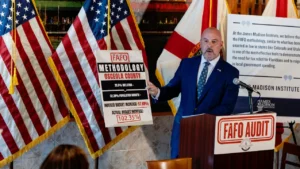
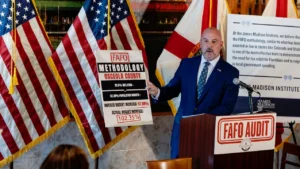
ST. CLOUD, Fla. — Florida Chief Financial Officer Blaise Ingoglia identified more than $165 million in what he described as excessive and wasteful spending within the Osceola County budget, the latest stop in a statewide effort to highlight local government spending ahead of a proposed property tax relief measure expected on Florida’s November ballot.
According to figures released by Ingoglia’s office, Osceola County’s General Fund budget has increased by 102.35% since Fiscal Year 2019-2020.
Ingoglia argued the growth far exceeds what many taxpayers would consider reasonable and said local governments have failed to prioritize tax relief despite years of expanding revenues.
“A budget increase of this magnitude for Osceola County is further proof that local governments have not been good stewards of taxpayer dollars,” Ingoglia said. “The excessive wasteful spending identified in Osceola County to the tune of $165 million is money that could have remained in the pockets of the families that live here.”
The announcement is part of a broader campaign by the Florida Agency of Fiscal Oversight (FAFO), which has been reviewing local government budgets across the state.
Budget Growth Outpaces Population
According to the CFO’s office, Osceola County’s budget increased by approximately $380.7 million over the past six years.
During the same period, county population growth totaled roughly 125,883 residents, representing an increase of 32.39%.
State officials argue the gap between population growth and budget expansion demonstrates opportunities for tax reductions without affecting core government services.
The report estimates that for every family of four added to Osceola County during that period, county spending increased by approximately $12,098.
Potential Property Tax Savings
The Florida Agency of Fiscal Oversight concluded that Osceola County could reduce its millage rate by 1.81 mills while maintaining current service levels.
If implemented, the agency estimates homeowners could save:
• $544 annually on a taxable home value of $300,000
• $725 annually on a taxable home value of $400,000
• $907 annually on a taxable home value of $500,000
Supporters of the proposal argue those savings demonstrate why voters should support broader property tax relief efforts expected to appear before Florida voters later this year.
Part of a Statewide Tax Debate
The Osceola County findings are the latest in a series of spending reviews released by Ingoglia since taking office as Chief Financial Officer.
According to his office, more than $3.6 billion in alleged excessive spending has been identified statewide through budget reviews conducted by FAFO.
Supporters say the reviews provide transparency and expose opportunities for taxpayer savings.
Critics of similar spending analyses have argued that local governments face increasing infrastructure, public safety, transportation, and growth-management costs that can make simple spending comparisons difficult.
Why It Matters
Property taxes remain one of the most significant political issues facing Florida homeowners.
As state leaders prepare for a possible constitutional amendment aimed at expanding property tax relief, reports highlighting local government spending are likely to play a larger role in the public debate.
The findings in Osceola County provide another example of how state officials are framing the argument that local governments can lower taxes while continuing to provide essential services.
What’s Next
Ingoglia has indicated that additional county spending reviews are expected in the coming months as the state continues examining local government budgets.
Meanwhile, Florida voters are expected to weigh a major property tax proposal in November that could reshape how homeowners and local governments share the tax burden for years to come.
The post Ingoglia Targets Osceola County Budget, Identifies $165 Million in Alleged Wasteful Spending appeared first on Florida Pundit.